
Medication Assistance
Thursday January 22, 2026
If there’s one thing that makes caregiving more difficult, it’s managing long lists of medications. Medications that could change often and may require accommodation for your loved ones to be willing or able to take the medication. While I can’t shorten the list or how many times a day you must deal with medications, here are some helpful hints to make it more manageable for you and your loved ones.
Inhalers
Let’s start with a device where I see a lot of struggle – inhalers. To properly use most inhalers, you have to blow all your breath out. Then, form a complete seal around the mouthpiece. You must then push the inhaler down and/or push a button to release the medication from the inhaler. As the medicine is released, you take a deep breath and hold your breath about eight seconds to get the medication to your lungs properly. Sometimes you have to do this more than once. With this many steps, you can bet memory loss complicates the process.
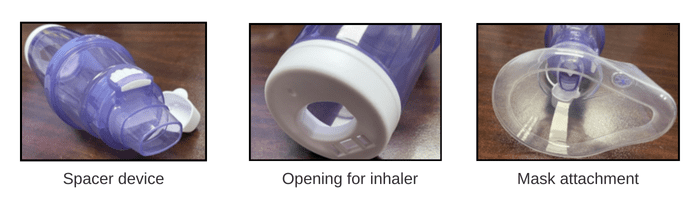
One handy tool you can use is a spacer. You can get them for $10 to $15 at the drugstore or online. Essentially, it contains the medication in a tube longer once it’s released allowing more time to breathe in and hold a breath. Some come with a mask attachment, as well, so your loved one can focus on breathing in deeply when needed. To use, insert the inhaler on one end of the tube and your loved one’s mouth is sealed on the other end of the spacer or is sealed by the mask attachment (nose and mouth). You can push the inhaler down and instruct your loved one to take a deep breath. If it is not deep enough the first time, the medication will still be contained in the tube, so you can be as patient as you need to and ensure the medication is received properly. The deep breath can be as slow as it needs to be. See the link below for an example.
It’s recommended to have water nearby after they use the inhaler, because it usually has an unpleasant after taste. If they are able to follow instruction well, it is best to just rinse their mouth and spit out the water to get the taste out.
Oral Medications
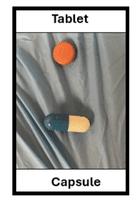
Memory loss can cause confusion about medications. Those with memory loss may think they’ve already taken the medication, or they may think you are trying to give them something they don’t want to take. Crushing medications with a crushing tool can certainly help, but keep a few things in mind. Most medications come in a tablet form. However, capsules are also common and the contents must be poured out to obtain the medication. Capsules are easy to spot from tablets because they are usually shinier and long rounded off shape. Some medications whether tablet or capsule are not able to be crushed because it affects how the medication works. For instance, many medications that have ER or XL after the name cannot be crushed. This is because these medications release slowly over the day and should not take effect all at once. A good practice is to ask your pharmacist ahead of time which medications can be crushed safely and add that information to your list.
 If you are able to crush tablets or open capsules, it may need to be administered in a spoon with something tasty like jelly, pudding, Jello or applesauce. Sometimes ice cream with some kind of texture in it or with sprinkles can also hide the crushed or even whole medications. If that doesn’t work, mixing crushed medications in coffee or tea could work with plenty of sugar/cream or Splenda to cover the taste of it. While it is much more preferred to use food to make sure all of the medication gets in, if that isn’t working, some medication getting in the body is better than none. Some days we just have to go with the flow. Taking a sip of water before taking the pills can help moisten the mouth and throat for the medicine to go down easier. There are even some pill lubricants that can be used to help make the pills more “slippery.” Sometimes, all it takes is using a pill cutter and making the pills small enough to manage. Either way, we want to get in as much as we can.
Other options may include asking if the medication can be prepared differently, such as a sublingual tablet, which can be placed under the tongue and dissolves, or a liquid form of the medication. Some medications can also come in cream or patch form. If you’re using a patch, it’s usually best to place it somewhere your loved one does not sweat easily and cannot easily see to pull it off. There may be assigned portions of the body to place the patch, but try to pick the least visible sight since many patches stay on more than one day. It’s also important to note that if your loved one is choking on pills at all a speech language pathologist may be able to help.
Injections/Blood Sugar Checks
Injections can be tough, but there are strategies to help. Most injections (but not all) given at home are subcutaneous, meaning it’s generally a short needle and given in the belly fat, sides of the thighs, or the fat on the back of the arm. Preparing the injection out of your loved one’s sight and not talking about it, as much as possible, would be best to reduce anxiety. Try to distract your loved one with conversation, TV show, or singing a favorite song with them while giving the injection.
You want to make sure you are using the proper technique to avoid pain as much as possible. Lightly pinch a small amount of skin in one of the fatty areas and insert the needle at a diagonal or 45 degrees, not straight on. Then, quickly push the medication in and take it out. This will minimize pain as much as possible. Further, you can minimize pain over time by rotating the sites you are using. Try to at least alternate the side of the sites you are using for injections. For those with diabetes, who must be pricked multiple times a day for blood sugar, it might be best to ask for a device that stays in the back fat of the arm on a two-week basis and can be used to read blood sugar levels with the tap of a smartphone. These can be out of sight and out of mind, because it is only one stick every two weeks. Ask your doctor if this might be an option for your loved one.

Please feel free to always bring any questions or concerns about medications to us. We will try and help with strategies to simplify the process and make it the most effective it can be for your loved one. Remember, always check with your doctor and pharmacist first before making any kind of alterations to medication assistance.
Written by Katie Fowler, Page Robbins Nurse